
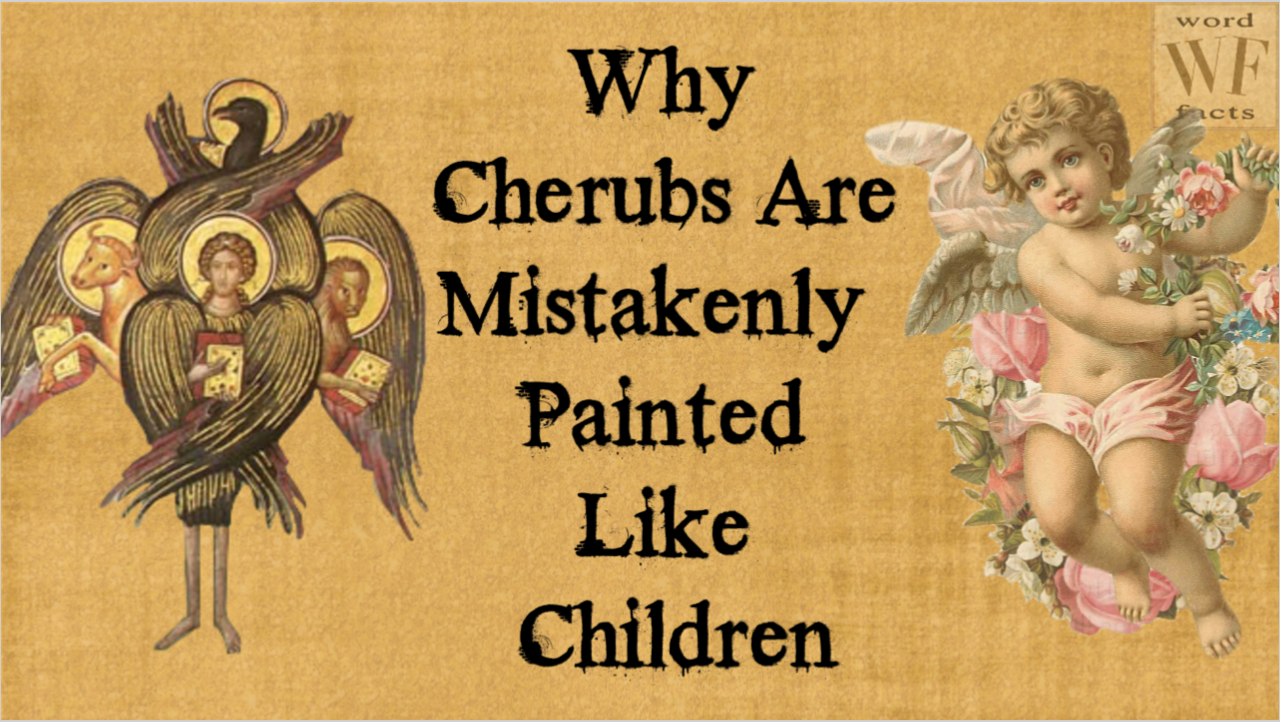
1903: Why Cherubs are Mistakenly Painted Like Children Mar 1, 2020
Cherubs are angelic beings, and in art they often depicted as childlike, but in the Bible they are described as having 4 heads, that of an eagle, an ox, a lion, and a man, and 4 wings—one set pointing up, and the other covering the body—each one with hands at the end, and humanoid legs with bronze-looking calf-hooves. Full descriptions can be found in the books of Ezekiel and Daniel, with mentions in many other places throughout the Bible. The difference between the artistic depictions is due entirely to rabbinic folk etymology, mistakenly relating the Hebrew כְּרוּב (keruv) to the Aramaic kĕ-raḇyā meaning 'like a child'. For an alternate term to describe these childlike creatures, it is more accurate to say 'putto', since the iconography actually comes from Greek and Roman mythology.
Support Word Facts on patreon.com/wordfacts
1902: democracy sausage Feb 29, 2020
In 2016, 'democracy sausage' was chosen as the word of the year by the Australian National Dictionary Centre. A democracy sausage just is a hotdog served in a slice of bread as opposed to a bun. This term came about in the last decade as many schools or other community centers, acting as polling stations, would host barbecues outside as a fundraiser. The term rose to especial prominence in 2016 however due to the national election that year.
Support this blog on patreon.com/wordfacts
1901: Right: Legal, Moral, and Directional Feb 28, 2020
Across languages, there is a strong correlation between words for 'straight' or 'right', and moral correctness. Lots of words, like 'strict', 'rule', 'upright', or conversely 'crooked' and idioms like "the straight and narrow" draw a clear comparison winding or bending as bad; even 'correct' and 'direction' also share this in their origins. Moreover, in law, 'right' has similar connotations. In many other languages these trends from law to slang are true as well, in French 'droit', Latin 'rectus', Greek 'dikaios' all can mean 'right' or 'just[ice]' as in law, in its direction, or with moral connotations. If you've know other cognates, leave it in a comment.
Support Word Facts on patreon.com/wordfacts
1900: war, victor, and vigor Feb 27, 2020
The older and more fundamental the concept, the more likely that words to define it will have relations elsewhere; this is true obviously just as a matter of chronology, but also that certain connotations will influence lexical development. For instance, there is a shared Proto-Indo-European relation between 'war' and 'victory'. From those two alone in English, this isn't overtly obvious, but from the reconstructed *weik-, many Indo-European languages have words related to strength (consider also 'vigor'), fighting (e.g. Latin 'vincere', or 'to conquer'), or something similar.
Support Word Facts on patreon.com/wordfacts
1899: ludwig, lewis, and luigi Feb 26, 2020
King Clovis' name comes from the Germanic root *hluda-wigaz ("famous in war"), but this is by no means the end of that story. Other first names from all parts of Europe including Ludwig and Lewis, or even the non-Germanic Luigi and Louis also derive from this root. Indeed, while it is originally Germanic, many Romance language have equivalents because of the Latinized form 'Ludovicus'. Many names are less obviously related however, including the Florentine 'Alvise' and the Swedish 'Love'. There are many more, so if you find one, leave it in the comments.
Support this blog on patreon.com/wordfacts
1898: clovis (point) Feb 25, 2020
It's pretty obvious that the idea of a spearhead would be related to war, but in one case these are etymologically related too, entirely accidentally. A clovis, or more specifically a 'clovis point' is a type of spearhead found from the retroactively named Clovis tribe, from where the archeological dig-site was in New Mexico. Moreover, the town itself was named for the Frankish king Chlodovech, or Clovis, in Latin. This is from the root *hluda-wigaz meaning "famous in war". More on that tomorrow.
Support this blog on patreon.com/wordfacts
1897: minister and master Feb 24, 2020
We probably all think of both 'master' and 'minister' as authoritative roles, but this has not always been the case. Namely with the case of 'minister' this is true, as it originally meant 'servant', sharing a root with the word 'minus'. 'Master' is the opposite of that in some ways, being a doublet with 'magistrate' meaning 'leader' from a Latin root meaning 'more'.
Support Word Facts on patreon.com/wordfacts
1896: Man and One: Nouns and Pronouns Feb 23, 2020
Across the Indo-European languages, there is often a relation between words meaning 'man' and words for the pronoun 'one'. This can be seen clearly in the German with 'man' ('one') and 'Mann' ('man'). However, the order of which form derived from the other is not universal across these languages. In German, as in French, the pronoun stemmed from the noun, but in English, 'man' was an indefinite pronoun centuries before it was a noun.
Support Word Facts on patreon.com/wordfacts
1895: The Creation of *Nous* Pronouns Feb 22, 2020
Pronouns are considered a closed lexical class, meaning it is particularly difficult to create new ones, and as a result, new meanings tend to come from other pronouns. This process is rare and slow, but in the case of the French 'on' in some informal settings it can be said to be replacing 'nous' as the 1st person plural pronoun. However, this didn't come out of thin air, as it also means 'one', as in the indefinite 3rd person pronoun. That sense didn't come out of nowhere either, and originated from the Latin 'homo' ('person') like the modern 'homme' ('man').
Support Word Facts on patreon.com/wordfacts
1894: Hen- and Stag-Do Feb 21, 2020
The formation for 'hen-do/hen-party' and 'stag-do' may seem odd, but they did not come about in a vacuum. Ascribing animals to a gender, and in particular connoting birds as feminine and bulls or stags as masculine has happened in some ways or another for milenia in some ways. Much of this, however, is not semantic, but stems from the fact that 'stag' and its cognates used to refer to any male animal, and including foxes and even dragons, and the same is true of 'hen' referring to any female bird. The use of these animals (including 'bulls') for same-gender gatherings has existed since that's 17th century for women, and at least the 19th century for me, though neither initially only related to prenuptial celebrations.
Support Word Facts on patreon.com/wordfacts
1893: Inheritable Surnames Feb 20, 2020
Since a surname indicates familial or even tribal affiliation, it is quite common for them to be patrilineal or regional, but would changing across generations therefore. However, some shifts throughout history changed this, namely with inheritable names. In 1808, Napoleon decreed that all people, including Jews who had never had inheritable names, adopt inheritable family surnames. This was applied across all the European areas he had dominion over, leading to the standardization of names in a fairly rapid period of time. Many people continued to use professional or geographically based names however.
Support Word Facts on patreon.com/wordfacts
1892: Nguyen Feb 19, 2020
Up to 40% of people in Vietnam have the last name Nguyen. This is actually originally Chinese, but its commonality is entrenched in Vietnamese history since the 13th century when the usurped Ly dynasty were forced to change their names to Nguyen. Over the next 2 or so centuries, another 2 collapsed dynasties changed their names to Nguyen. Aside from many other nobles who were given the name Nguyen, many criminals took it up to blend in. Other popular names in Vietnam mostly come from old dystic names as well.
Support Word Facts on patreon.com/wordfacts
1891: Squitter Feb 18, 2020
Although the notions of hyena noises and watery diarrhea seem disparate, there is one word that can describe both: squitter. Although rare in both cases, and archaic in the latter, 'squitter'—also used in radio—refers to random pulses. This therefore described a certain type of radio frequency, bowel movements, and occasionally the method of hyena communication.
Support Word Facts on patreon.com/wordfacts
1890: Intensive Forms (Binyanim) Feb 17, 2020
Certainly there are intensive forms for certain words like 'shatter' to 'break', but these sorts of form exist well beyond just the lexicon or phrases, like 'bloody well' in "I bloody well will do that". In Hebrew, there is a distinction in which binyan—essentially which vowel templates get added into the verbs themselves—is used, meaning that all verbs etc. can have a distinction between intensive and causative forms in a way that is only possible, sometimes, through using totally different words in English.
1889: Intensive Forms (Semantics) Feb 16, 2020
There are lots of ways words can come in pairs, but when it comes to intensive forms, these pairs are entirely semantic. For instance, comparing 'shatter' to 'break', and the only similarity—as none exist in the grammar, etymology, phonology etc.—is that the latter is the intensive form of the former, that is 'break' is forceful whereas 'shatter' is not. In some languages, especially semitic languages, these pairs would be more obviously related, but that is not always necessary.
Support Word Facts at patreon.com/wordfacts
1888: costard and costermonger Feb 15, 2020
Normally, when people talk about combining forms, they simply refer to endings which add meaning but don't change the classification of the word. This description can be made of '-monger' in words like 'fishmonger' or 'cheesemonger', since '-monger' cannot exist on its own, but in the case of 'costermonger', the root word also changes, albeit not grammatically. A costermonger is an apple-salesman (not the Steve Jobs kind) named for the type of apple 'costard', which itself comes from the '-ard' suffix on a meaningless stem 'cost-'.
1887: Unknown Lexicon in Hungarian Feb 14, 2020
Hungarian was identified as being similar to other Uralic languages like Finnish or Estonian back in the late 17th century, but many things are still mysterious. While much of the vocabulary, about 22% can be identified as Uralic, 30%, the plurality of Hungarian's total lexicon, is considered as being of unknown origin. This, and other influences, especially Turkic influence, is not the only difference between other modern Uralic languages and modern Hungarian, but it certainly is a noticeable one.
Support Word Facts on patreon.com/wordfacts
1886: Latin in Hungary Feb 13, 2020
Latin was once spoken across Europe and North Africa; after the collapse of the Roman Empire, some nations clung onto it. However, the Kingdom of Hungary, established in AD 1001 used Latin as the sole official language for over 800 years until 1836. Bear in mind that this is nearly 6 centuries after the fall of Rome, and the Hungarians were never under Roman rule, as their ancestors came to Europe much later.
Support Word Facts on patreon.com/wordfacts
1885: Yen, Yuan, and Won Feb 12, 2020
Names for currencies from East Asia, including Yen, Yuan, and Won are all etymologically similar. The Japanese 'yen' is derived from the original Chinese, but they have different meanings; here it's literally 'round'. This is because that, and 'yuan' (silver), come from the phrase 'yínyuán' or literally 'silver round', denoting coins. Both Korean wons also mean 'round' and are cognates.
Send Word Facts any of these—or other—currencies at patreon.com/wordfacts
1884: złoty and leu Feb 11, 2020
In the case of some currency names like 'dollars', 'shekels' or 'francs', the names are fairly abstract, but for many currencies this isn't the case. The Polish 'złoty' is also slightly odd insofar as it is an adjective meaning 'golden', not a noun, but the name is clearly reasonable. In Romania, the currency is 'leu', or literally 'lion'; these are however subdivided into 100 'bani', which translated directly as 'money'.
Send over your own currency at patreon.com/wordfacts