
2064: (Some) Semitic Origins of English Letters Aug 8, 2020
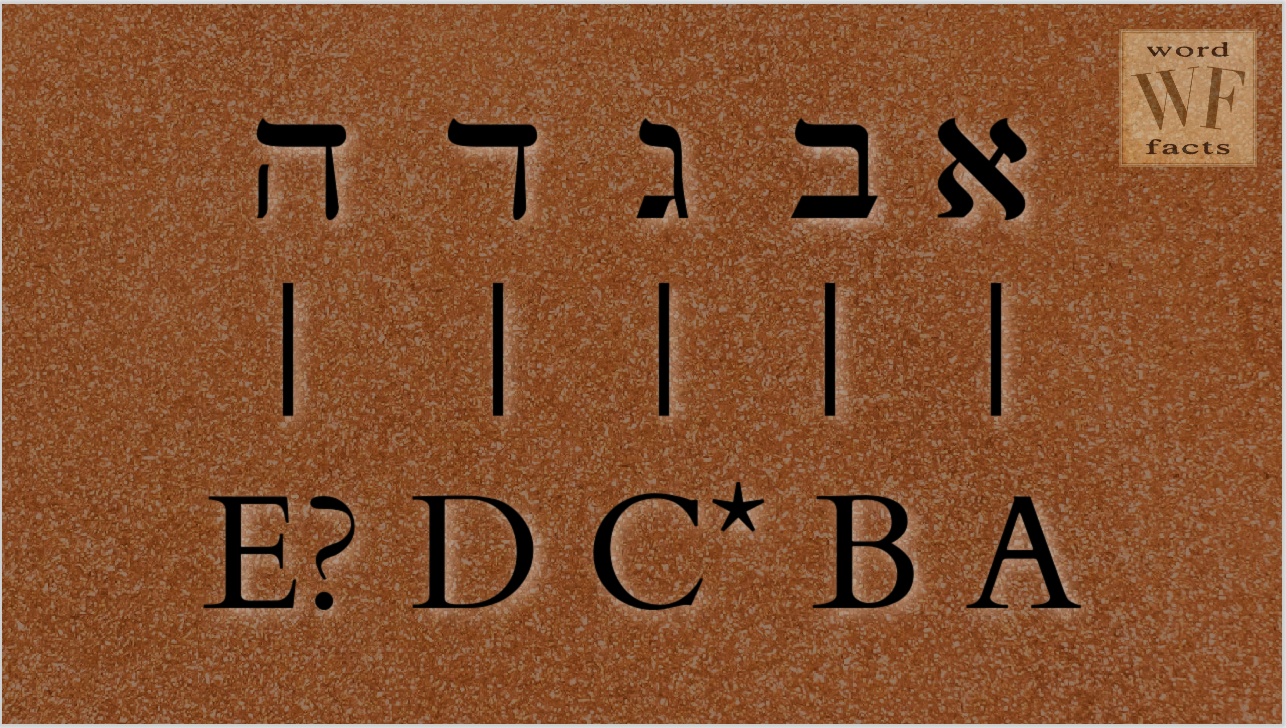
The Greek alphabet which inspired the Latin alphabet was ultimately of Semitic origins. Therefore, there is a general the Hebrew writings system corresponds to the Latin alphabet in many ways. The first 4 letters for instance, א,ב,ג,ד often correspond in terms of pronunciation roughly like ABGD (G comes as a variant of C), but the 5th letter in Hebrew is ה which corresponds in appearance and often pronunciation to H, but actually the Hebrew ה gave rise to the letter E, also the 5th letter. The relations between the placement of the letters does stop after the respective 6th letters though.
Watch the newest video, about classifying historical languages.
Get Word Facts Merch.
Support on Patreon.com/wordfacts
2063: Im(par)sible Words Aug 8, 2020
Certain parts of whole phrases simply can't exist on their own, outside of the syntax in which they exist. These elements, such as 'jinks' of "high jinks", 'caboodle' of "kit and caboodle", or 'kith' in "kith and kin". There are plenty more, so leave it one in the comments if you know. Indeed, in some of these cases such as with 'caboodle', there is not even a totally clear meaning, whereas at least 'kith' means 'friends' or 'acquaintances', from the Old English for 'known' or in this sense 'familiar'. Other elements (in this case words) are meaningingful even if rarely parsed, like how "room and board" uses 'board' to mean food (or literally a table set with food) but outside of that phrase people would likely opt for another word.
Watch the newest video, about classifying historical languages.
Get Word Facts Merch.
Support on Patreon.com/wordfacts
2062: How the Austro-Hungarian Military Replaced Personnel Aug 7, 2020
As discussed before, the Austro-Hungarian Empire arranged its troops partly by linguistic background. This policy enacted in the 1860's proved to be difficult to maintain during the Great War however, for two reasons. The first and more obvious was that it made replacements very difficult to manage, or otherwise a troop would have different native linguistic backgrounds. The other issue is that in order for officers to be moved around they would have to learn a new language often; they were given up to 3 years in some cases but even that is often not sufficient, particularly in the case of Hungarian, but also it is a long time for an army to have to wait for proficiency.
Watch the newest video, about classifying historical languages.
Get Word Facts Merch.
Support on Patreon.com/wordfacts

2061: Language Use in the Austro-Hungarian Military Aug 6, 2020
One might wonder how the Austro-Hungarian Empire ran its military in such a multilingual society. This is especially true since the military was one of the few institutions that was not run separately between Austria and Hungary. First of all, every division would be arranged by language, though this was not always true of the officers; this will be the topic for the post tomorrow. That said, because this was run centrally, there was a list of 80 or so commands all in German which every soldier needed to memorize. Indeed, while the recruitment of soldiers roughty mirrored the wider demographic makeup including about a quarter of native German speakers, a majority of the officers were native German speakers and this was the language of command more generally.
Watch the newest video, about classifying historical languages.
Get Word Facts Merch.
Support on Patreon.com/wordfacts

2060: Names for Limericks Aug 5, 2020
Many different standard, poetic meters have names. Many people may be familiar with the phrase 'iambic pentameter', kept in the many people's minds still today because of Shakespeare. Another popular meter is that of a limerick, but the name for the exact series of stressed and unstressed syllables is called an anapest
Watch the newest video, about classifying historical languages.
Get Word Facts Merch.
Support on Patreon.com/wordfacts
2059: Inspiration for 'Oz' Aug 4, 2020
The 1900 book "The Wonderful Wizard of Oz" has a lot of silly made up names in it, like slaves of the Wicked Witch known as 'winkies', a kingdom called ‘Oogaboo’, and a robot named ‘Tik-Tok’ to name a few. However, the author stated that the name 'Oz' was inspired by a far more dull source: filing drawer labeled O-Z.
Watch the newest video, about classifying historical languages.
Get Word Facts Merch.
Support on Patreon.com/wordfacts
2058: -General Aug 3, 2020
Many former colonial states have governors general, which was a figurehead appointed by the ruler of the colonial empire in order to act as a representative to that head of state. However, there were other titles notable for having the adjective follow, including governor regional, who oversaw different provinces within the colony, and of course surgeon general and attorney general who also confer information to the leader and keep certain duties in check.
Watch the newest video, about classifying historical languages.
Get Word Facts Merch.
Support on Patreon.com/wordfacts
2057: Hurricanes vs. Typhoons Aug 2, 2020
Basically, a hurricane and a typhoon are the same thing insofar as they are tropical storms. The main difference really is where they originate, with hurricanes coming from the Atlantic and particularly the Caribbean, and typhoons originating in the Indian or Pacific Ocean; based on the respective colonial history, the former is more American (and Spanish) and the latter is more British. That said, if such a tropical storm hit Guam and then Hong Kong, it would not be referred to locally as a hurricane first, but a typhoon for both because it is in the Pacific.
Watch the newest video, about classifying historical languages.
Get Word Facts Merch.
Support on Patreon.com/wordfacts
2056: Republican Seals, and Other Emblems Aug 1, 2020
Turkey made the news for supposedly going to make a coat of arms, but it still has not; many claim it is the only country in the world not to do so, but this is technically false. it is false in the sense that while all other countries have a sort of national symbol in use, not all of these are coats of arms. Many countries in the Americas and also France have a 'republican seal' which was designed by the Americans in revolutionary times so as to not associate this emblem with monarchy and other republican uprisings followed suit. Furthermore, some countries like Thailand, India, and Japan use individual, religious symbols—though in the former two cases it is not of the majority religion—that act as a national symbol but are neither crests nor seals.
Watch the newest video, about classifying historical languages.
Get Word Facts Merch.
Support on Patreon.com/wordfacts

2055: Words for Wine across Linguistic Boundaries Jul 31, 2020
Wine is something that has been shared around the Mediterranean and beyond, both literally and also linguistically. Old, basic concepts tend to have lots of related cognated across related languages, but in the case of 'wine' it is actually shared across unrelated languages as well. 'Wine' in English comes from a Proto-Indo-European (PIE) root '*uoin-a-', and there are plenty of other PIE-descended words too, like the Latin 'vinum'. Likewise, there are many related non-PIE words like the Georgian ღვინო (gvino), the Armenian գինի (gini), the Hebrew יין (yáyin), the Amharic ወይን (wäyn), and the Swahili 'mvinyo'. Of course, many of these words, including those of Africa and Northern Europe especially will be borrowed, but there is no consensus as to whether this original root is from a Semitic, Indo-European, or even Kartvelian language; some theories will be more convincing than others though.
Watch the newest video, about classifying historical languages.
Get Word Facts Merch.
Support on Patreon.com/wordfacts

2054: Washington Football Team, and Other NFL Changes Jul 30, 2020
The NFL team formerly known as the 'Washington Redskins' has officially announced an interim name of the 'Washington Football Team' until another permanent name is selected. The move was done after years of calls to remove the title given its offensive and pejorative meaning. This is not the first time that a team has changed its name though without moving to a different location, such as the New York Titans to the New York Jets in 1963, or how the Pittsburgh Pirates, who shared the same name as the baseball team, became the Pittsburgh Steelers.
Watch the newest video, about classifying historical languages.
Get Word Facts Merch.
Support on Patreon.com/wordfacts
2053: Chocolatine, Pain au Chocolat, or Other... Jul 29, 2020
In France, there are two main words for a chocolate croissant, neither of which are 'croissant' despite the fact that English took that word from French. In most of France, this is known as a 'pain au chocolat' (chocolate bread) whereas in the Southwest region it is called 'chocolatine' as shown in the map below. The fact that is is called a 'croissant' at all in English is a bit odd anyway considering that it does not retain the shape of a true croissant (or 'cresent'), but in any case, the pastry actually originated in Austria using the name 'Kipfel' which may themselves been an old pagan tradition, so really what does it matter‽
Watch the latest video.
Get Word Facts Merch.
Support on Patreon.com/wordfacts

2052: max factor Jul 28, 2020
Max Factor is a makeup company, but it actually comes from another name. Although the company name makes a certain amount of sense, it is actually from Polish originally. The founder was named Maksymilian Faktorowicz, who was a Polish beautician.
Watch the latest video.
Get Word Facts Merch.
Support on Patreon.com/wordfacts
2051: sabiro Jul 27, 2020
The word for 'suit jacket' in Japanese is 'sabiro', which may not sound like a loan word from English, but it is. It isn't a direct transfer for 'suit' however. The word comes from the association with the fashions of London at the time, specifically around the street Saville Row, known even today for its tailors and generally men's fashion.
For the newest in Word Facts fashion, check out the new shirts.
2050: Making the Omelette without Breaking Eggs: Walter Duranty Jul 26, 2020
A New York Times correspondent for the USSR and Pulitzer Prize winner in 1931, Walter Duranty, helped to cover up the Holodomor, a man-made famine in Ukraine. It is within this context of dismissing and suppressing this story while also glorifying the USSR that many accounts claim he helped to popularize the expression "you can't make an omelette without breaking a few eggs". Of course, most people who use it are unaware of this, and it has a generally neutral connotation.
For further information, read the New York Times discretization of his work here, including other examples.
2049: French in North America Jul 25, 2020
French is spoken in parts of North America, particularly around Quebec and possibly Saint-Pierre and Miquelon, but those aren't the only places. Louisiana still has some native French speakers descended from the original settlers, but far smaller communities like that also exist in places like Missouri and even Minnesota. The sizes of those communities those are very small—some estimates placing in the low double-digits.
New Merch is available here

2048: Ye and The Jul 24, 2020
The word 'the' has had a number of spellings, in part because of how simple and common it is. Like other symbols including & for 'and', 'the' used to be typed as 'ye' to make use of what was available on German printing presses, but actually this was just an approximation of another, older Germanic letter. In fact, it was often spelled in exotic ways to save space, as exhibited in the document shown below.
New merch available from the store

2047: The Assimilation of Gender Jul 23, 2020
English spelling and pronunciation don't always match neatly, but in the case of 'fiancé' and 'fiancée', or 'blond' and 'blonde', the words (essentially) mean the same thing and are pronounced the same; the only difference is that the first ones, without the final -e are masculine, and the others feminine. This is changing in English, however. Since the mid-1970's uses of the phrase "blond woman" have actually been used even more than "blonde woman", though it is next to impossible to find instances of 'blonde man'; this period in time saw similar trends with 'fiancé'. In general, and as has been discussed here before, gendered words—especially when the only variation is in the spelling—are disappearing from English, but almost universally trending towards the masculine as a universal.
Watch the latest video.
Get Word Facts Merch.
Support on Patreon.com/wordfacts
2046: Real Inspirations for Star Trek Jul 22, 2020
Star Trek was in small part inspired by the actual exploration of Cpt. James Cook. Indeed, the name of the captain in the original 1960's show named James Kirk is named similarly in accordance. Moreover, the name for the spaceship, the Star Trek Enterprise was inspired after Cook's ship, the HMS Endeavour.
Watch the latest video.
Get Word Facts Merch.
Support on Patreon.com/wordfacts

2045: SPQR, and Conjunctions in Initialisms Jul 21, 2020
The standards for what make something a word that can be used for acronyms is variable, and this is even true of the words themselves. The Roman initialism SPQR stands for 'Senātus Populusque Rōmānus' (The Roman Senate and People) looks to only be made up of 3 words, but the suffix '-que' in Latin is one of the ways of expressing 'and'. Indeed, other languages with affixed conjunctions like Hebrew include these sometimes as well. Usually, conjunctions or prepositions etc. won't be included in English acronyms/initialisms however, but there are exceptions like DoJ (Department of Justice).
Watch the latest video.
Get Word Facts Merch.
Support on Patreon.com/wordfacts