
2104: If Need(s) Be Sep 18, 2020
As with a few other phrases, there is a split between "if need be" and "if needs be", even if there are some slight differences to how the two will be placed in a sentences. The rarer by far is "if needs be"; it’s a linguistically normal phrase, albeit a bit archaic. The ‘be’ part of it is again somewhat dated, a form of the subjunctive, but not wholly uncommon given that fact, such as when considering
“Let it be”
“If it be [is]”
“If need be”

2103: The Many Names of Rosh Hashona Sep 17 2020
The Jewish new year holiday, Rosh Hashona, goes by many names, but 'Rosh Hashona' (ראש השנה), literally 'head of the year' actually only appears once in the Bible—Ezekiel 40:1—and it's much later than when initially mentioned. It is first mentioned in Leviticus as Zichron Teruah (זכרון תרועה) meaning "a memorial of blowing [of the shofar]". It is elsewhere however referred to as Yom Teruah (יום תרועה) meaning 'Day of Blowing' (the Shofar) and prayers it is referred to has Yom Hazikaron (הזכרון יום), though now this is also a secular Israeli Memorial Day and is not so used for Rosh Hashona.
Watch the newest video, about historical languages.
Get Word Facts Merch.
Support on Patreon.com/wordfacts

2102: Paleo-Hebrew (Abjad) Sep 16, 2020
The writing system used for Hebrew is certainly ancient, but it is not the original written form for Hebrew. The paleo-Hebrew alphabet was used in the Israelite kingdoms until the Babylonian conquest. All texts, including the Bible, were written in that script at the time, such as in the Dead Sea Scrolls. The current Hebrew abjad, known as Jewish Square Script is actually from the Assyrians. The Samaritans still use a script based off the paleo-Hebrew writing system.
Watch the newest video, about historical languages.
Get Word Facts Merch.
Support on Patreon.com/wordfacts

2101: How to Abbreviate in Other Writing Systems
In punctuation, a 'full stop' can indicate the end of a sentence, but also periods are used for abbreviations, so how does abbreviation work in other writing systems? Cyrillic and Greek—both also have letters and distinguish between upper- and lower-cases—basically do the same as English: mostly capital letters sometimes though not necessarily separated with periods. In Arabic this is more complicated because there are 4 forms depending where it is in the word (e.g at the beginning, middle, end, or in isolation) as opposed to 2 cases, and the words are written with the letters connected. Abbreviations are rare in Arabic but the few that exist use periods between letters in the isolated form. In cases like with Japanese where whole pictographs are used will simply reduce characters such as 国際連合 (United Nations), which is made of 国際 (international) and 連合 (union) to make 国連: the first character of each part of the compound. Hebrew will put two marks (“gershayim”) between the penultimate and last letters, such as with שב״כ from שירות הביטחון הכללי (Sherut ha-Bitaẖon haKlali), and it is common that these will be pronounced as their own words (in this case 'shabak') and therefore spelt with the word-final letter forms when relevant.
Watch the newest video, about historical languages.
Get Word Facts Merch.
Support on Patreon.com/wordfacts
2100: The Nonsense of "Proper Adjectives" Sep 14, 2020
Although the term 'proper adjective' is used for orthographic purposes, it is syntactically meaningless. In English, people will distinguish a proper adjective as one formed from a proper noun; this does not happen in other languages like German for instance. Proper nouns are nouns which do not take an article, such as given names, which is a syntactically relevant distinction. While a word like 'Austria' would be a proper noun because it's the name of a country, nothing inherently distinguishes 'Austrian' from a common adjective like 'massive in "massive strudel" or 'Austrian strudel", even though both are formed from nouns. Therefore, the fact that it is capitalized will actually not indicate anything about the grammar. This also happens with verbs and adverbs such as 'Americanize'—proper only in name but not functionally different—but these are less common than adjectives usually. Scrabble does not allow for so-called proper adjectives.
Watch the newest video, about historical languages.
Get Word Facts Merch.
Support on Patreon.com/wordfacts

2099: Liberal pt. 2 Sep 13, 2020
The word 'liberal' has many connotations today, but most have strayed from the original. Before it had expressly political associations, it really just referred to anything that was suitable for a gentleman, i.e. not tied to a specific trade; this sense is maintained in the term 'liberal arts'. The word also meant 'generous' and eventually 'not bound by restraint'. The political connotations came only recently in history. The word is also probably related to 'frank' (the people-group), as in 'free man' not as in 'honest' necessarily.
Watch the newest video, about historical languages.
Get Word Facts Merch.
Support on Patreon.com/wordfacts
2098: Bécs: Why Vienna Has Different Names Sep 12, 2020
Although there are plenty of places with exonyms—names for somewhere originating outside of that area—names for 'Vienna' have some clearly different exonyms in Eastern European languages. For instance, the German language name is 'Wien' hence the English term, but in Hungarian, Romanian, Turkish, Serbo-Croatian, the word approximates *Bec, even though none of those languages are related. It is presumed to come from Avar or Proto-Turkic. There is also an exception in Slovenian with 'Dunaj', coming from the Danube river that goes through Vienna.
Watch the newest video, about historical languages.
Get Word Facts Merch.
Support on Patreon.com/wordfacts
2097: Temporal Morphology in Somali Nouns Sep 11, 2020
People will probably be familiar with 'tense' as a concept relating to verbs; even words that explicitly relate to time like the adverb 'before' and the noun 'yesterday' don't have tense because they don't change to indicate time in the way that "I swim" does compared to "I swam". In Somali, it is definitely possible for nouns and adjective, and even some other parts of speech like articles and adverbs to change due to tense. For instance, notice the vowels at the end of the nouns in:
A) dhibaatóoyinka adag ee ká tagaan Soomáaliya
problems(-detM) difficult and (abl) arise Somalia
"The serious problems that arise in Somalia”
B) dhibaatóoyinkii adaa ee ká tagaa Soomáaliya
problems(-detM) difficult [+past] and (abl) arose [+past] Somalia
"The serious problems that arose in Somalia”

2096: Semitic Roots: Blood, Man, and Earth pt. 2
As discussed yesterday, there is a clear connection between the words for 'man', 'blood', and 'earth' in Semitic languages from the root א-ד-ם (a-d-m). What is less clear, is how this came to be. There are several theories about the order of this; generally it is agreed that 'blood' was the first meaning, but whether that led to 'man' i.e. someone who has blood, or that 'red earth/clay' was first and the meaning of 'man' is more like 'earthling' is the cause of some debate. Another theory is that this started with the word 'idol' as in 'like a man' but also something for which blood sacrifices (were) made; in that case, it has less of a connection to dirt, but would have a greater connection to the other two meanings.
Watch the newest video, about historical languages.
Get Word Facts Merch.
Support on Patreon.com/wordfacts
2095: Semitic Roots: Blood, Man, and Earth pt.1
There are a number of English words with etymological connections to the ideas of both dirt and red such as 'rust' and 'rubric' (originally referring to a stamp made of clay) but this same pattern is much clearer in Hebrew with the words אדום (adom) for 'red', and אדמה (adama) for 'earth'. This root in Hebrew also makes 'אדום (adam) for 'man' and is related to the Akkadian word 'adamu' for 'blood' from the root '*dam'. There will be more on this in the following post.
Watch the newest video, about historical languages.
Get Word Facts Merch.
Support on Patreon.com/wordfacts
2094: ten-hut Sep 8, 2020
The word 'ten-hut' is a military drill command from the word 'attention', but such as to be easier to yell, sort of. The consonants themselves are indeed different, but given that [h] and [t] constrict airflow more than either or [n], it is if anything harder to project for volume. This is doubly so of the version used with in the air-force, 'tench-hut' which just adds another consonant. Nevertheless, not only it is one syllable shorter, it also has emotional connotation and so the exact consonants aren't necessarily so significant.
Watch the newest video, about historical languages.
Get Word Facts Merch.
Support on Patreon.com/wordfacts
2093: Period or Full Stop Sep 7, 2020
In US, the term for the symbol "." is called a 'period' whereas in the Commonwealth nations it is usually 'full stop'. The word 'period' can be dated back to the times of Old English with a Latin loanword 'periodos', but the meaning has not always been the same. The terms really solidified with printing terminology 'full point', a point being a unit of measure. The use of 'full stop' was used as a way to distinguish from the symbol's use in abbreviations and so on.
Watch the newest video, about historical languages.
Get Word Facts Merch.
Support on Patreon.com/wordfacts
2092: "Hair of the Dog" and Other Hangover Cures Sep 6, 2020
There are a lot of phrases that people probably use without even knowing the full version. For instance, the phrase "hair of the dog" refers to drinking more alcohol to cure a hangover, but the full phrase is "hair of the dog that bit you" as was once a cure for rabies (not sound medical advice, by the way). The idea of using more of the problem as a solution exists in many languages as a reference to alcohol especially, but it will often come in different forms, like in Slavic languages which reference using a wedge to remove a stuck wedge, or in other Germanic languages meaning 'repair-beer', like the Austrian German 'Reparatur-Seidl'.
Watch the newest video, about historical languages.
Get Word Facts Merch.
Support on Patreon.com/wordfacts

2091: Gender in German Country Names: Articles Sep 6, 2020
In German, countries will not need a definite article ('das') if the country is neuter, but for masculine and feminine one is required. Most countries and other words for places like continents are neuter, which is easy in this case. It means for instance that while one would say “Deutschland liegt in Europa” (Germany lies in Europe) which lacks an article, people would say “der Irak liegt in Vorderasien.” (Iraq lies in the Middle East). Most Middle Eastern countries are masculine in German.
Watch the newest video, about historical languages.
Get Word Facts Merch.
Support on Patreon.com/wordfacts
2090: Turkish Special Letters: İ and ı Sep 4, 2020
Most people, regardless of language would associate the i (with a tittle) with being lower case, but this would not be true for the Turks. The Turkish writing system is modified from the Latin alphabet including <ğ> <ç> and <ş>. Along with those İ/i and I/ı represent different phonemes, and so have separate lower- and uppercase forms. Azerbaijani, a Turkic language, also has a special letter ə, capitalized as Ә.
Watch the newest video, about historical languages.
Get Word Facts Merch.
Support on Patreon.com/wordfacts

2089: Original Meaning of Comma, Period, and Colon | Sep 3, 2020
Today, commas, periods, and colons are all terms for punctuation, but this was not any of their original senses, looking back at those words’ histories. Indeed, all of them were rhetorical terms or used for poetry. A comma in Latin referred to a short phrase, line of a poem, or a clause of a sentence; period referred a complete sentence or “full pause”, and colon just referred to a part of a poem, and comes from Greek, literally ‘limb’. Of those, ‘colon’ has likely changed the most, as it referred to far more substantial divisions than it does now.
Check out the new video: https://www.youtube.com/watch?v=a3qWOEUXr3k
Get Merch: teespring.com/stores/word-facts
Support on Patreon.com/wordfacts

2088: week Sep 2, 2020
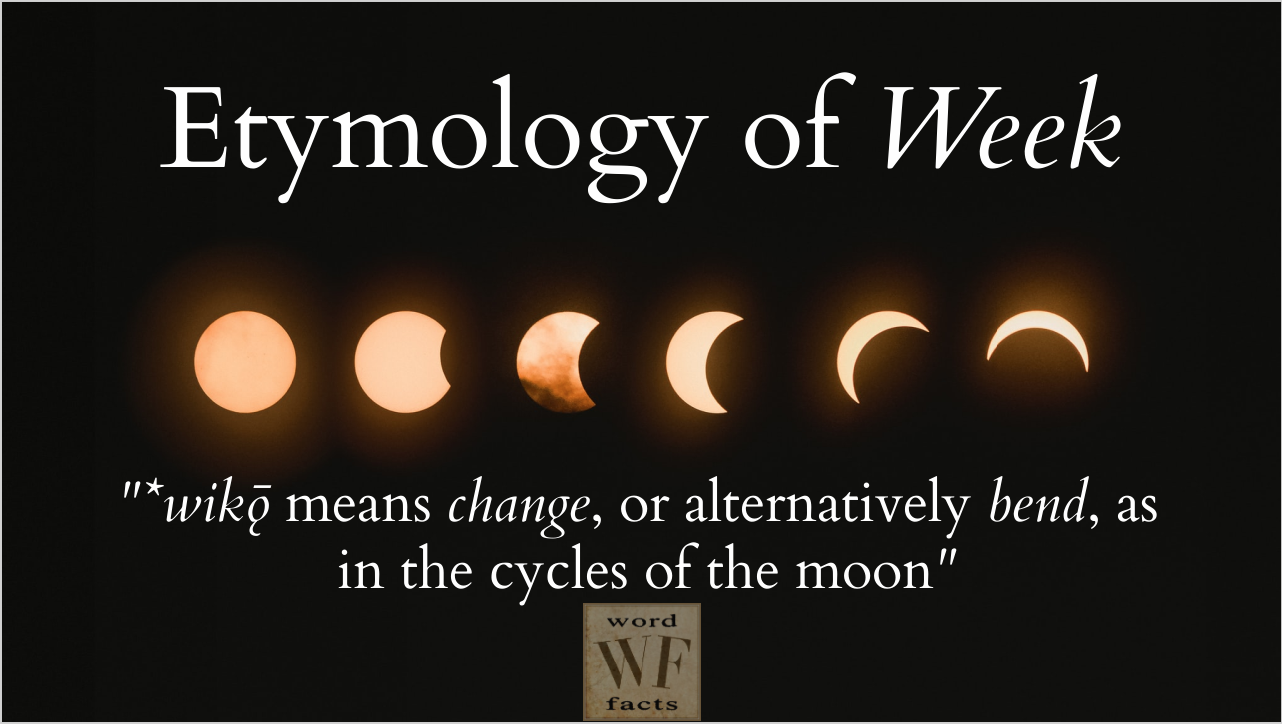
Time has many subdivisions, but the more natural ones are related to seasons and the cosmos. 'Month' comes from the same root as 'moon' for instance, but there is a similar situation with 'week'. It comes from the Proto-Germanic root *wikǭ meaning 'change', or alternatively 'bend', as in the cycles of the moon; a week is roughly 1 quarter of a full lunar cycle, but the specific 7-day period was only adopted with the spread of Christianity anyway. This makes the word 'week' also related to 'vicar' and the prefix 'vice-', through the sense of 'alternate'.
Watch a video about the significance of 7 (day week) here.
2087: Functions of Diacritics in Hebrew Sep 1, 2020
Hebrew uses an abjad rather than an alphabet, meaning the vowels are not written. There are diacritics (known as nikudos) written above (e.g פֿ / פ), below, or inside the letters (e.g. תּ / ת). Some of these will indicate vowels, but other functions exist as well, including for cantillation and changing the nature of consonants, as with the examples before, depending on tradition. Because they can be written in multiple places and have different functions—only included later in history—in certain texts multiple per letter will be used. In the special case of the 10 commandments, the word תִּֿרְצָֽח (“you will murder”) has 3 diacritics on the first letter in some versions, because the dot inside תִּֿ as well as the line above function the same but are used in different traditions; merely תִּ is more traditional here though because line known as 'rafe' is no longer used for Hebrew and so is just less practical.
Watch the newest video, about historical languages.
Get Word Facts Merch.
Support on Patreon.com/wordfacts
2086: vicar Aug 31, 2020
Now used exclusively by the Church, the terms 'vicar' and and 'diocese' come from Roman administrative terms, used in the government of that empire. 'Vicar' was used to mean 'second in command' in Rome but it came to mean 'deputy' (i.e. a divine proxy) ecclesiastically. It actually comes from the root 'vicārius' meaning 'change' refers more to the idea of 'interchange' like 'vicarious' means today. In the case of the Vicar of Bray (1540) though, he famously was a Catholic vicar twice, and also a Protestant vicar in the span of 48 years in the same place, making the meaning more literal.
Watch the newest video, about historical languages.
Get Word Facts Merch.
Support on Patreon.com/wordfacts
2085: Feminine Origins of 'Kilt' Aug 30, 2020
People would probably not be terribly surprised to learn that the word ‘kilt’ comes from the same root as ‘skirt’; they are both from Old Norse and basically look the same. What people might not have guessed is that the root of kilt is a lot more feminine than that, as that root has been traced back to the Proto-IndoEuropean root ‘gelt-’ meaning ‘womb’. Indeed, the English word ‘child’ ultimately comes from that root, as do other child-rearing related words like the Swedish ‘kilta’ (to swathe/swaddle).
Watch the newest video, about historical languages.
Get Word Facts Merch.
Support on Patreon.com/wordfacts